
GuidesAll utilities
Contestable and non-contestable work explained
Which parts of a new water, electricity or gas connection you can get competing quotes for, and which only the network operator can do.
Every new water, electricity or gas connection has two kinds of work in it. Some of it, only the company that owns the network can do. The rest is open to competition: an accredited partner can do it instead, and you can get competing quotes for it.
The industry calls these non-contestable and contestable work. The words are clumsy, but they appear on every connection quote, so they’re worth knowing.
The short version
Contestable work is work your partner can do. It’s usually most of the build: designing the new network on your site, digging the trenches, laying the pipes or cables, and connecting each plot.
Non-contestable work is work only the network operator can do. It’s the work that touches or affects the network already supplying other customers: deciding where you can connect, upgrading the existing network if your site needs more capacity, and often the final connection to the live network.
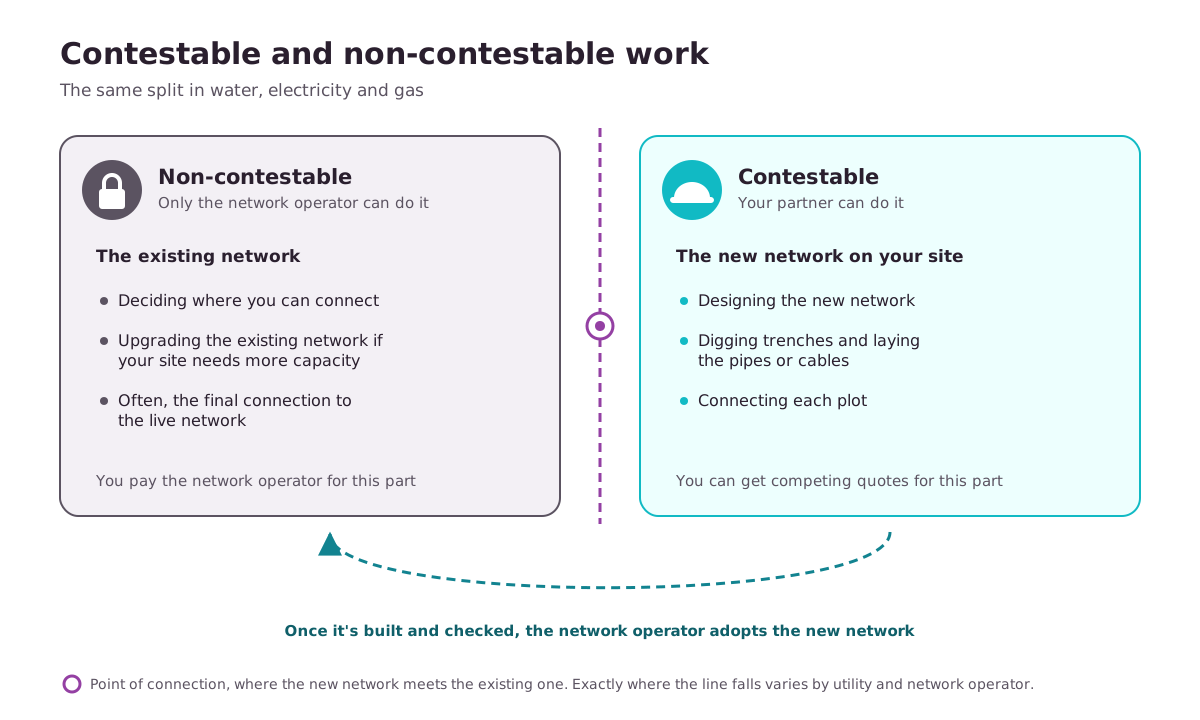
Once your new network is built and checked, the network operator adopts it. It takes ownership and looks after it from then on, whoever built it.
Why the split exists
Connections were opened up to competition to give developers more choice over who builds the network on their site, and to improve service and bring down costs. The network operator keeps the work that affects the network already supplying other customers.
How it works in each industry
The idea is the same in water, electricity and gas. What changes is the partner’s title and exactly where the line falls.
Water. Here the partner is called a self-lay provider. New mains and the service pipes to each plot are normally contestable. In England every water company publishes a yearly list of the activities a partner can do, and it can’t offer less than a national minimum. The final connection to the live main is contestable for some types of connection; for the rest, the water company makes it.
Electricity. Here the partner is called an independent connection provider (ICP). Designing the new network, laying cables and building a substation are contestable. The network operator normally keeps deciding the point of connection, designing any upgrade to its existing network, and switching the new network on. Some operators let an accredited partner take on parts of that work too.
Gas. Here the partner is called a utility infrastructure provider (UIP). Laying mains and services, excavation and jointing are contestable, up to the final tie-in. The network operator often makes the final connection itself, unless your partner holds the accreditation to do it. New housing needs gas less and less, though. New homes in Scotland have had to use zero direct-emission heating since April 2024. In England, the Future Homes Standard applies to new homes from 24 March 2027, with transitional arrangements for projects already under way, and in practice it means new homes will use low-carbon heating, such as heat pumps, rather than gas boilers.
Each industry has its own accreditation scheme for partners: WIRS for water, NERS for electricity and GIRS for gas. LRQA runs all three, and a partner accredited under one scheme can work in any network operator’s area for that utility.
What it means for your costs
You always pay the network operator for the non-contestable work, whoever does the rest.
For the contestable work, you choose. The network operator can do it, or you can ask partners to quote and compare. In electricity, network operators can price the whole job or just the non-contestable part, so you can see which part of the cost is open to competition.
When you compare quotes, check that they assume the same point of connection, and see what each includes: design, reinstatement, meters, and any network operator fees passed through.
The price you’re quoted early on can change once the detailed design is done, particularly if it shows the existing network needs upgrading.
A third option: an independent network operator
On some sites you can go a step further, and have an independent network operator own and run the network on your site instead of the local one. In electricity this is an independent distribution network operator (IDNO), in gas an independent gas transporter (IGT), and in water a new appointment and variation (NAV). It connects to the local network at a single point. We’ll cover this in its own guide.
What to check first
- Which network operator covers your site, for each utility.
- The non-contestable cost on its own, so you know the part of the price that isn’t open to competition.
- That each partner is accredited for the work you need.
- Who makes the final connection, and who pays for it.
- Whether the price has been confirmed at detailed design, before you fix your budget.
We share each new guide on LinkedIn. Follow us there so you don't miss the next one.
Sources
- Ofgem, Competition in electricity distribution connections
- Ofwat, Code for Adoption Agreements
- Water UK, Code of Practice for the Self-Laying of Water Mains and Services
- LRQA, Utility Schemes factsheet (WIRS, NERS, GIRS)
- MHCLG, The Future Homes and Buildings Standards: Building Circular 01/2026
- Scottish Government, New Build Heat Standard factsheet
- Water UK, Water Sector Guidance (approved documents)
- The Building (Scotland) Amendment Regulations 2023 (New Build Heat Standard)
- Ofwat, New connections
- Western Power Distribution, Small connections