
GuidesWater
Self-lay explained
How an accredited partner can build the water main and connections on your development, who you pay, and what stays with the water company.
If your development needs a new water main, you don’t have to wait for the water company to build it. You can appoint an accredited partner to design and lay the main and the connections to each property. In the water industry this partner is called a self-lay provider. The water company checks the work and then takes it over as part of its network.
This works the same way for homes, commercial units and mixed-use sites.
Self-lay is available in England and Wales. In England the process is set by Ofwat’s Code for Adoption Agreements, so it is the same whichever water company covers your site. The Ofwat code doesn’t apply in Wales, so there you work to the Welsh water company’s own terms.
Electricity and gas work the same way: an accredited partner builds the connection, and the network operator takes it over. Only the partner’s title changes. In electricity it’s an independent connection provider (ICP), and in gas a utility infrastructure provider (UIP). This guide covers water.
What self-lay means
Some of the work on a new water supply is “contestable”: any accredited partner can do it, so you can get competing quotes. Laying a new main is contestable. So, in most cases, are the service pipes that connect each property.
To do this work, a partner must be accredited under the Water Industry Registration Scheme (WIRS), run by LRQA. Water companies across mainland Britain recognise WIRS accreditation, so one accredited partner can work in any region.
Once the main is built and tested, the water company adopts it. From then on it owns and maintains the main, exactly as if it had built it itself.
Who does what
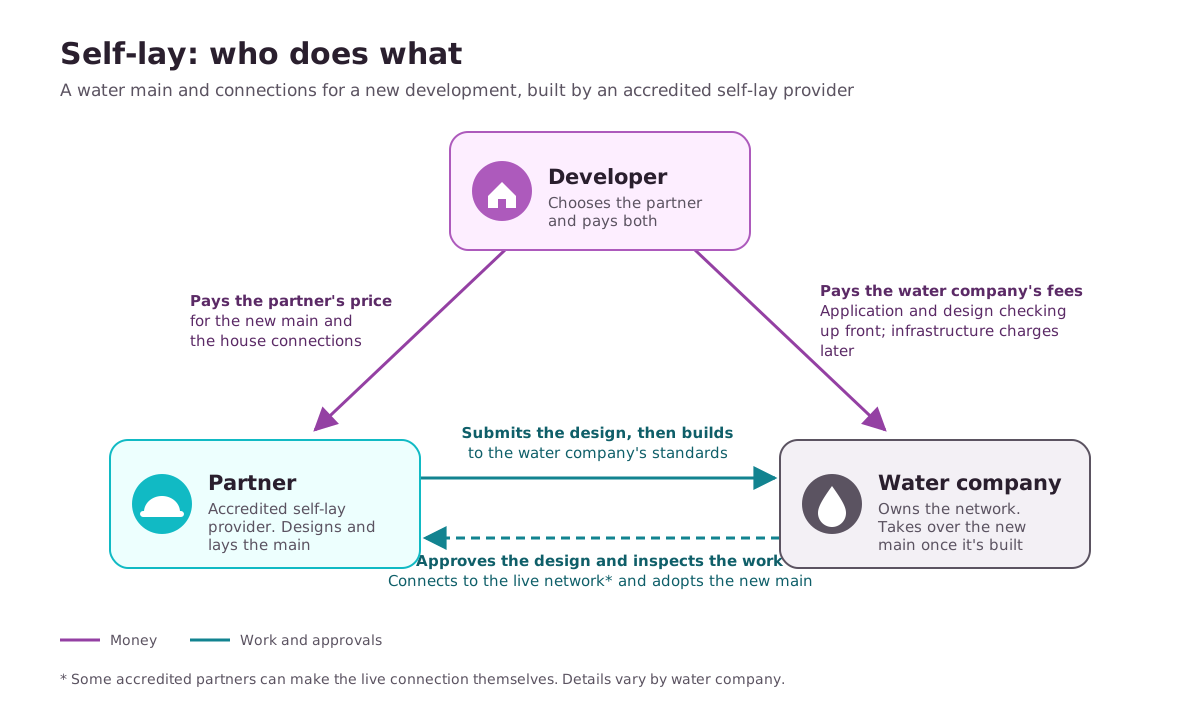
You, the developer, choose the partner and sign the adoption agreement. This is a standard contract between you, the partner and the water company, based on a national model agreement.
Your partner designs the main (or uses a design from the water company), lays it to the water company’s specification, and installs the service pipes to each property.
The water company confirms where you can connect, approves the design, inspects the work, and adopts the main once it’s finished. Depending on the company and the size of the pipe, either the water company or your partner makes the final connection to the live network.
What you pay, and to whom
On a self-lay job you don’t pay the water company’s prices for the contestable work. Your partner’s price replaces them.
You still pay the water company directly for some charges. Every water company publishes its own amounts each year, but the kinds of charge are the same wherever you build:
- Application, design-checking and administration fees. Your partner (or an accredited designer) produces the design, so the water company charges to check it rather than to design it. Many water companies also charge administration or legal fees, and some charge a small fee for each connection. You pay most of these up front, with the application. The amounts depend on the size and type of scheme.
- Infrastructure charges. A charge per property towards the wider water and sewerage network. You pay these however the main is built. When they fall due depends on the water company’s charging arrangements. Water companies in England must also offer environmental incentives: payments to developers for water-efficient or sustainable drainage design. Ask what applies and how to claim.
Each property still needs a meter. Depending on the water company, your partner either buys the meters itself or gets them from the water company at a published price. Ask your partner whether meters are included in its quote.
The water company doesn’t pay you or your partner for the main it adopts. Payments like this, called asset payments, stopped in England in April 2020.
How a self-lay job runs
In England the steps are the same at every water company, because they follow the same industry guidance:
- Point of connection. The water company confirms where the new main can connect to its network.
- Design and terms. The design is submitted and approved, and the water company issues the adoption agreement.
- Terms accepted. You, your partner and the water company sign.
- Construction. Your partner lays and tests the main, and the water company inspects it.
- Adoption. The main becomes part of the water company’s network.
- Service connections. Your partner connects each property as it’s ready.
Why choose self-lay
The main reason is price. You can get quotes from more than one accredited partner and set them against the water company’s published rates, which every company in England has to publish each year.
You also get more say over timing. Your partner builds to a programme agreed with you, and the water company’s part becomes approvals and inspections.
Self-lay also comes with service standards. In England, water companies must meet published service levels at each stage of a self-lay scheme, such as issuing the design and terms. When they miss certain ones, the industry rules require them to refund the fee for that step without being asked.
What to check first
- Your partner is accredited for the work you need. You can check on LRQA’s WIRS register.
- Which water company covers your site, and its published charges for this year.
- Who makes the live connection at that water company, for your pipe sizes.
- What your partner’s quote includes: design, the water company’s fees, meters and reinstatement.
- Whether your site is in Wales. Self-lay works there too, but the Ofwat code covers England only, so the Welsh water company’s own terms apply.
We share each new guide on LinkedIn. Follow us there so you don't miss the next one.
Sources
- Ofwat, Code for Adoption Agreements
- Water UK, Code of Practice for the Self-Laying of Water Mains and Services
- Dŵr Cymru Welsh Water, Self-lay
- LRQA, Water Industry Registration Scheme (WIRS) register search
- Water UK, Water Sector Guidance (approved documents)
- LRQA, Utility Schemes factsheet (WIRS, NERS, GIRS)
- Ofwat, English New Connection Rules (from April 2026)
- Ofwat, New connections charging rules from April 2020: decision document
- Yorkshire Water, Charging arrangements for new connections 2026/27
- Thames Water, Charging arrangements for new connection services 2026/27